Kitchen Notes Baking tools The kitchen scale I weigh every bake on, and four more worth knowing
Kitchen Notes / Baking tools

The kitchen scale I weigh every bake on, and four more worth knowing

Cups measure volume and ovens care about weight. A good scale closes that gap and quietly makes everything you bake more repeatable.

Anna Lind Harper
by Anna Lind Harper
Updated 2026-07-12 · 8 min read
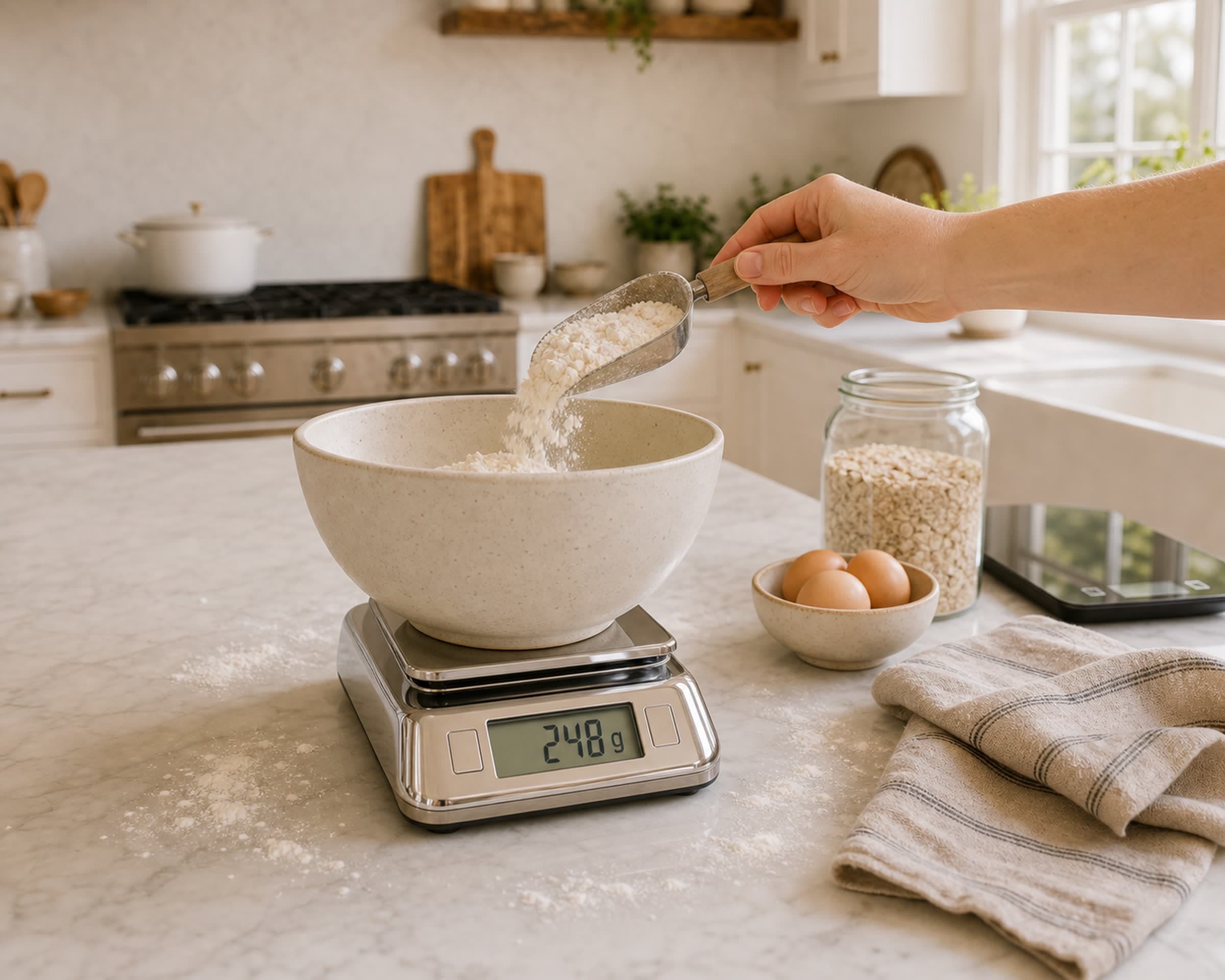
A digital kitchen scale on a marble counter weighing flour into a ceramic bowl mid-recipe, with a second scale and a jar of oats softly out of focus behind it.
DISCLOSUREThis post may contain affiliate links. As an Amazon Associate, I may earn from qualifying purchases at no extra cost to you. I only recommend tools I actually use.
The short answer
For the people skimming.
If you only buy one
The Escali Primo

Accurate, simple, sealed against flour dust, and mine has weighed every loaf on this site.

Best value
The Greater Goods scale

Does the whole job for less than a bag of good bread flour costs.

The bread baker's pick
The My Weigh KD-8000

Baker's percentages built in, and a long-standing cult following among home bread bakers.

Here is my honest position: of everything on my counter, the kitchen scale is the least glamorous tool and the one that has improved my baking the most. Cups measure volume, and volume fibs. The same cup of flour can come out fluffy or packed, which is why a loaf behaves one week and sulks the next. A scale ends that quietly, one gram at a time, and mine has been ending it since before this site existed.

The first pick below is that scale, with years of flour on it. The rest is the research I would do for a friend: what test kitchens keep agreeing on, what owners still praise after years of sticky doughs, and where paying more actually shows up in the bowl. Here is the kitchen scale I weigh every bake on, and four more worth knowing.

Side by side

At a glance.

#
Pick
Notes
Best for
01
Escali Primo Digital Kitchen Scale
11 lb, 1 g
Best overall
See pick ↓
02
Greater Goods Digital Kitchen Scale
11 lb, 1 g
Best value
See pick ↓
03
OXO Good Grips 11 lb Stainless Steel Scale
11 lb, pull-out display
The upgrade
See pick ↓
04
My Weigh KD-8000 Baker's Scale
17 lb, baker's %
The bread baker's pick
See pick ↓
05
American Weigh Scales AWS-201 Pocket Scale
200 g, 0.01 g
The precision one
See pick ↓
The picks

Ranked.

Each one with its honest pros, real downsides, and what I actually cook in it. Listed in the order I'd recommend buying them.

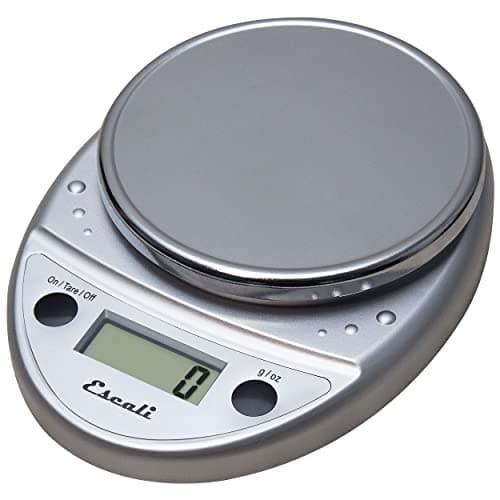
A chrome Escali Primo digital kitchen scale with a rounded platform and two sealed buttons.
No. 01
Tier
Budget
See on Amazon
01
Best overall

Escali Primo Digital Kitchen Scale

Escali

This is the scale on my counter, and it has weighed the flour for every loaf, bun, and cookie on this site. The whole design is two sealed buttons, a platform, and a display, which is exactly as much scale as baking needs. It reads in 1 gram steps up to 11 pounds, the sealed panel wipes clean after the messiest sourdough morning, and the pair of AA batteries I put in it have outlasted whole seasons of baking. The real feature is not on the box: once you weigh flour instead of scooping it, your recipes start behaving the same way twice.

What I love
  • Two sealed buttons and nothing else to break or gum up with flour
  • Accurate at 1 gram across the whole 11 pound range
  • Runs seemingly forever on two AA batteries
  • Big enough platform for a mixing bowl, small enough for a drawer
Worth knowing
  • Whole-gram steps shrug at yeast and salt in small amounts
  • The display sits close to the platform, so the very widest bowls can shade it
Best for
The default pick. Anyone who bakes from this site and wants results that repeat.
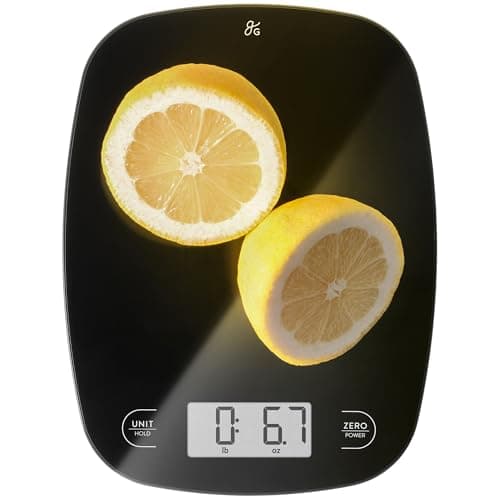
A slim black glass Greater Goods digital kitchen scale with a backlit display.
No. 02
Tier
Budget
See on Amazon
02
Best value

Greater Goods Digital Kitchen Scale

Greater Goods

The honest budget answer, and the one I suggest when someone is not sure weighing is for them. It costs less than a bag of good bread flour, tares with one press, and reads in the same 1 gram steps as scales that cost several times more. Owners keep reporting the same thing year after year: it just keeps working. The slim glass body slides into a drawer like a paperback, which is more than the bulkier scales here can say.

What I love
  • Extremely affordable without reading like a toy
  • Slim enough to live in the shallowest drawer
  • Simple tare and unit buttons, no menu diving
  • Consistent 1 gram readings, which is all baking asks
Worth knowing
  • The auto-off window is shorter than I would like
  • Light enough that a heavy bowl set down carelessly can shift it
  • The glass top shows every floury fingerprint
Best for
First scales, small kitchens, and anyone testing whether weighing is for them.
Recipes I make in this one
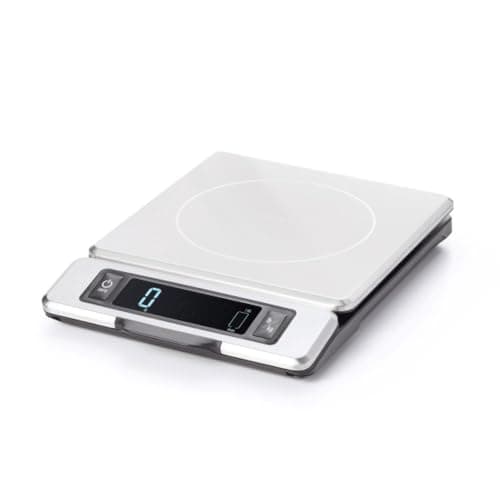
An OXO Good Grips stainless steel kitchen scale with its display pulled out from under the platform.
No. 03
Tier
Mid-range
See on Amazon
03
The upgrade

OXO Good Grips 11 lb Stainless Steel Scale

OXO

The scale the test kitchens keep ranking first, and the reason is one moving part: the display pulls out from under the platform. Set your widest mixing bowl on top and the numbers slide out from underneath and stay readable, which solves the single most common everyday annoyance with kitchen scales. The stainless platform lifts off for washing, the buttons are big enough for floury fingers, and the whole thing feels like it was designed by someone who actually bakes.

What I love
  • The pull-out display stays readable under any bowl
  • Removable stainless platform wipes truly clean
  • Clear backlit numbers, readable in dim morning light
  • The build quality gap over budget scales is obvious in the hand
Worth knowing
  • Real money for a kitchen scale
  • The battery compartment is fiddlier than it should be
  • Bulkier in the drawer than the slim budget picks
Best for
Frequent bakers who weigh into wide bowls and want the nicest version of this tool.
Recipes I make in this one
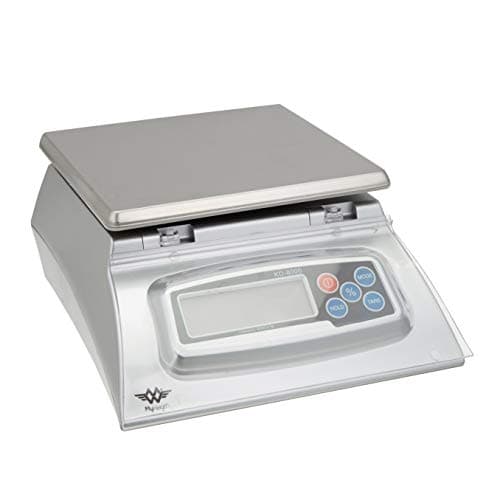
A silver My Weigh KD-8000 kitchen scale with a large square platform and baker's percentage buttons.
No. 04
Tier
Mid-range
See on Amazon
04
The bread baker's pick

My Weigh KD-8000 Baker's Scale

My Weigh

The scale with the cult following, and the following is deserved. It does baker's percentages on the scale itself, so you can size a dough up or down without a calculator, and its 17 pound capacity laughs at a dutch oven full of levain. Best of all, the auto-off is adjustable and can be turned off entirely, which fixes the most complained-about behavior in this whole category. It is big, it is beige, and it looks like it belongs in a lab, and none of that matters once you bake bread with it.

What I love
  • Baker's percentage mode built into the scale
  • Auto-off can be extended or disabled completely
  • Huge 17 pound capacity with a big stable platform
  • A decade of loyal owners and cheap replacement parts
Worth knowing
  • A big footprint that earns permanent counter space, like it or not
  • Whole-gram steps only, so it still wants a pocket scale beside it
  • The looks are strictly functional
Best for
Bread bakers, batch bakers, and anyone who has ever yelled at a sleeping scale.
Recipes I make in this one
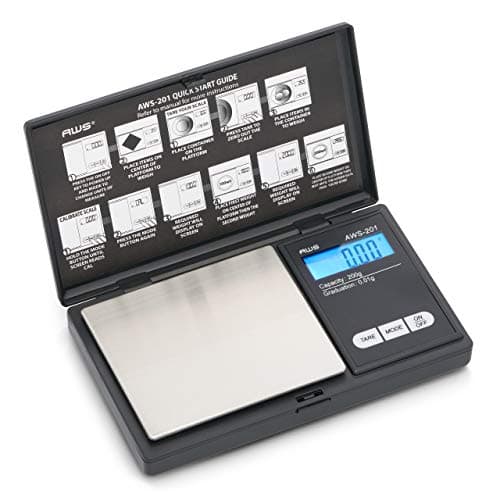
A small black American Weigh Scales pocket scale with a flip-open cover and a precision digital display.
No. 05
Tier
Budget
See on Amazon
05
The precision one

American Weigh Scales AWS-201 Pocket Scale

American Weigh Scales

Not a replacement for a kitchen scale, a companion to one. This little pocket scale reads in hundredths of a gram, which sounds absurd until a bread recipe asks for 3 grams of yeast and your big scale offers you 2, maybe 4, hard to say. Yeast, fine salt, baking soda, and spices are where whole-gram scales quietly round your recipe into a different recipe. It costs about as much as a good loaf pan and removes the last bit of guesswork from small measurements.

What I love
  • Reads in 0.01 gram steps, perfect for yeast and salt
  • Small enough to live inside the baking drawer
  • Flip-open cover doubles as a little weighing tray
  • Removes the guesswork from the smallest, most sensitive amounts
Worth knowing
  • Tiny platform fits ramekins, not bowls
  • Maxes out at 200 grams, so it is strictly a second scale
  • Feels more like a gadget than a kitchen tool
Best for
The second scale in the drawer, for the small amounts a big scale rounds into guesswork.
Recipes I make in this one
Buying guide

How I'd shop for one from scratch.

01
Grams beat cups, every time

A cup of flour can weigh anywhere from about 120 to 150 grams depending on how it was scooped, and that spread is the difference between a tender crumb and a brick. Grams end the argument. If a recipe gives weights, use them; every baking recipe on this site does.

02
Resolution and capacity are a pair

You want both ends: 11 pounds of capacity so a heavy bowl plus ingredients fits, and 1 gram steps so small amounts register. Below 1 gram, do not chase one scale that does everything; add a small pocket scale for the tiny stuff instead.

03
The auto-off problem

The most common complaint about every kitchen scale is that it goes to sleep while you fetch the butter, taking your tare with it. Check how long the shutoff window is before you buy. Only one pick here lets you turn auto-off off entirely, and bread bakers love it for exactly that reason.

04
Readability under a wide bowl

A mixing bowl wider than the scale shades the display, and suddenly you are weighing by faith. A display that pulls out, or at least sits well forward of the platform, is worth paying attention to if your bowls are generous.

05
When a pocket scale earns its spot

If you bake bread, a scale that reads tenths or hundredths of a gram stops being silly the first time you weigh yeast. Salt, baking soda, and spices in the 2 to 6 gram range are all measured more honestly on a small precision scale.

The questions I get

Frequently asked.

Do I really need a kitchen scale for baking?

For cooking, no; taste and adjust. For baking, a scale is the cheapest accuracy upgrade that exists. Flour measured by cup can vary by a quarter of its weight depending on scooping, and bread and enriched doughs feel that immediately. Weighing is also faster and dirties fewer cups.

Can one scale handle everything, including yeast?

Almost. A standard 1 gram scale covers flour, butter, sugar, and liquids perfectly. It struggles with the small stuff: 3 grams of yeast or 4 grams of salt can round up or down by a third. If you bake bread often, a small pocket scale beside the main one solves it for very little money.

How accurate does a home kitchen scale need to be?

One gram steps up to about 11 pounds covers home baking completely. You can sanity-check any scale with pocket change: a United States nickel weighs 5 grams. If five nickels read 25 grams, your scale is telling the truth.

What do I do when the scale turns off mid-recipe?

Set out everything you plan to weigh before you start, so ingredients go into the bowl in one unbroken run. If your baking rhythm involves wandering to the fridge mid-measure, pick the scale here with adjustable auto-off and simply turn the feature off.

More kitchen notes

From the tool drawer.

All kitchen notes →
A hand mixer whipping cream to soft peaks in a ceramic bowl on a marble counter, with cookies cooling on a rack and two more hand mixers waiting in the background.
Baking8 min read
The hand mixer I bake with, and four more worth knowing

The hand mixer behind every cookie on this site, plus a budget workhorse, a cordless one, and the best hand mixer picks for how you actually bake.

Glass meal prep containers being filled with a colorful grain bowl lunch on a marble counter, a row of filled containers with lids waiting beside the board.
Pantry8 min read
The meal prep containers I actually use, and four more worth knowing

The glass food storage set my meal-prep Sundays run on, plus the deli containers every cook secretly swears by, a leak-proof lunch pick, and two more worth knowing.